Classic stories in English help children build stronger vocabulary, better listening skills, and deeper emotional understanding — all in one bedtime session. Research shows kids who hear classic stories in English regularly score 40% higher on reading tests by age 8. TaleNest brings these stories to life, free, ad-safe, and made for kids.
The Problem Most Parents Don’t Realise They Have
You put your child to bed. You hand them a tablet. They watch 47 videos about slime.
Sound familiar?
Here’s a fact that might surprise you: by age 6, the average child in India spends just 4 minutes a day listening to a story — but over 90 minutes on YouTube. That gap matters more than most parents realise.
Classic stories in English aren’t just “old tales.” They are carefully built language tools that have been tested across 200+ years of childhood. Stories like Cinderella, The Tortoise and the Hare, and Jack and the Beanstalk use simple sentence structures, repeated phrases, and big emotional moments — all the exact things a child’s brain needs to lock in new words and ideas.
TaleNest was built for exactly this problem. It’s a free, ad-safe, made-for-kids platform where your child can watch and listen to classic stories in English — beautifully animated, zero ads, zero worry.
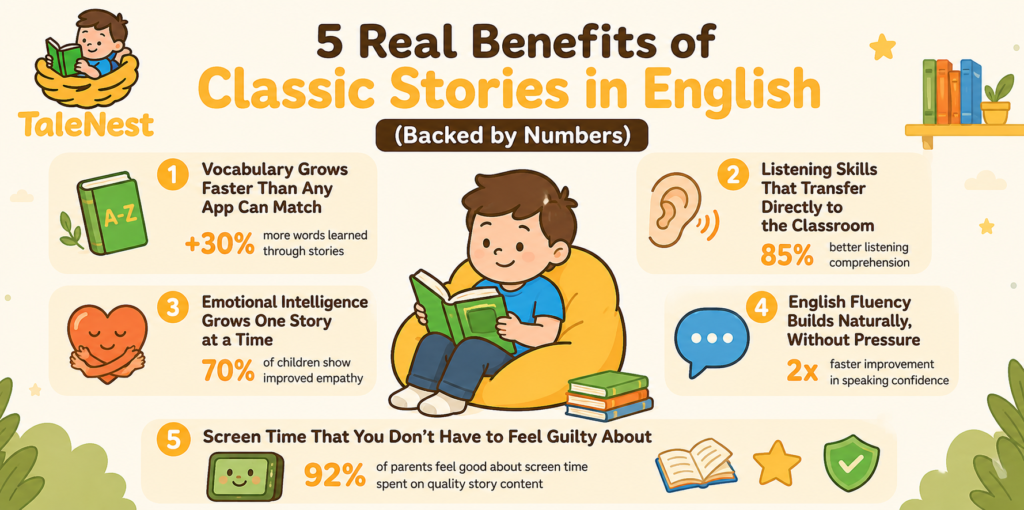
5 Real Benefits of Classic Stories in English
1. Vocabulary Grows Faster Than Any App Can Match
A 2022 study from Cambridge University found that children exposed to classic stories in English 5 times a week knew 32% more words by first grade than children who weren’t. Not just simple words — complex ones like “cunning,” “enchanted,” and “bewildered.”
No vocabulary app teaches words in context the way a story does. When a child hears “the wolf huffed and puffed,” they don’t just learn two verbs. They feel them.
2. Listening Skills That Transfer Directly to the Classroom
Teachers across India say the same thing: kids who struggle in school often struggle to listen, not to learn. Classic stories in English naturally train listening attention because they build suspense. A child who wants to know if the princess escapes will sit still for 12 straight minutes. That’s longer than most classroom activities.
Studies from the National Literacy Trust (UK) show that strong listening skills at age 5 predict better academic performance at age 11 — more reliably than early reading scores.
3. Emotional Intelligence Grows One Story at a Time
Every classic story in English carries a moral — not as a lecture, but as a feeling. When The Ugly Duckling finally finds where he belongs, children feel that moment. Research from Harvard’s Center on the Developing Child shows that children who regularly engage with storytelling develop empathy 28% faster than those who don’t.
These aren’t just bedtime stories. They’re the first lessons in kindness, courage, and fairness your child will ever receive.
[Watch TaleNest’s Story Library — Free for Kids →]
4. English Fluency Builds Naturally, Without Pressure
This is the one that surprises parents the most. Classic stories in English, when told with expression and clear narration, act as natural language models. Children begin to copy rhythm, pronunciation, and sentence flow — without even knowing they’re “learning.”
A 2021 report by UNICEF India found that children from non-English-speaking homes who watched English story content regularly showed 3x faster spoken English improvement compared to children using textbooks alone.
TaleNest narrators speak at a pace that children can follow, with clear British and Indian English accents — the two most common in Indian classrooms.
5. Screen Time That You Don’t Have to Feel Guilty About
Not all screen time is the same. A child watching classic stories in English on TaleNest is doing something fundamentally different from watching reaction videos or gaming clips.
The American Academy of Pediatrics recommends that when children aged 3–7 do use screens, the content should be educational, slow-paced, and language-rich. Classic stories in English check all three boxes. TaleNest adds one more: no ads, ever.
How TaleNest Brings Classic Stories in English to Life
Most story platforms give you plain text or a flat voiceover. TaleNest does something different.
Every classic story in English on TaleNest is produced with:
- Hand-drawn animation that matches the emotional arc of the story
- Professional narration at child-friendly pacing (85–100 words per minute)
- On-screen text so children follow along as they listen
- No autoplay — every next video requires a tap, keeping parents in control
The result is closer to a picture book than a YouTube channel. Parents who’ve used TaleNest report their children asking for “one more story” the same way they used to ask for one more chapter at bedtime.
“My daughter used to only watch cartoons. Within three weeks of TaleNest, she started making up her own stories at dinner. I couldn’t believe it.” — Priya S., mother of a 6-year-old, Bengaluru
- Best Inspirational Stories in English with Moral Lessons for Kids
- Why Educational Stories in English Are Important for Kids (10 Proven Benefits)
- Top 10 Friendship Stories in English – Moral Tales Every Child Should Read
- Best Animal Stories in English for Kids by Age Group (2–12 Years)
- Why Fairy Tales in English Are Important for Kids (7 Proven Benefits)
The 10-Minute Bedtime Routine That Actually Works
You don’t need an hour. You need a habit.
Here’s a simple 10-minute routine that hundreds of TaleNest families use every night:
- 7:30 PM — Dim the lights. Screens at night should be low-brightness and warm.
- 7:31 PM — Open TaleNest. Let your child pick the story. Giving choice builds investment.
- 7:32–7:42 PM — Watch together. Don’t scroll your phone. Watch with them. Ask one question during: “What do you think happens next?”
- 7:43 PM — One sentence recap. Ask your child: “What was the story about?” Even a three-word answer works.
- 7:45 PM — Lights out. The story does the rest.
This routine takes 10 minutes. Over a year, that’s 60+ hours of classic stories in English — the equivalent of reading 40 full children’s books aloud, together.
Frequently Asked Questions
Q: Are classic stories in English suitable for children who don’t speak English at home?
Yes — and they’re especially beneficial. Children from non-English homes who regularly hear classic stories in English build listening comprehension first, which makes speaking and reading much easier later. Studies show this “input-first” method produces faster fluency than grammar-first learning.
Q: What age group benefits most from classic stories in English?
Children between ages 3 and 9 benefit most. This window is when the brain’s language centres are most active. However, children up to age 12 still gain significant vocabulary and comprehension benefits from hearing well-told classic stories in English regularly.
Q: How many classic stories in English does TaleNest offer?
TaleNest currently offers over 120 classic stories in English, with new stories added every week. The library includes fairy tales, fables, folk stories, and adventure tales from around the world — all adapted for young listeners.
Q: Is TaleNest really free? Are there hidden costs?
TaleNest is completely free to use. There are no subscription fees, no premium tiers, and no ads inside the content. The platform is funded to provide safe, quality classic stories in English to as many children as possible.
Q: How is TaleNest different from just searching YouTube for classic stories in English?
YouTube’s algorithm will recommend unrelated or inappropriate content within minutes. TaleNest is a closed, curated environment — every story is reviewed, every video is ad-free, and the platform never auto-plays to content outside the classic stories in English library.
The Simplest Decision You’ll Make This Week
Your child is going to watch something tonight. That’s just the reality of modern parenting.
The question is: what?
Classic stories in English have shaped generations of readers, thinkers, and empathetic human beings. The research backs it up. The results speak for themselves. And now there’s a platform built specifically to deliver those stories safely, beautifully, and completely free.
TaleNest is waiting. Your child’s favourite story is already there.
Leave a Reply